
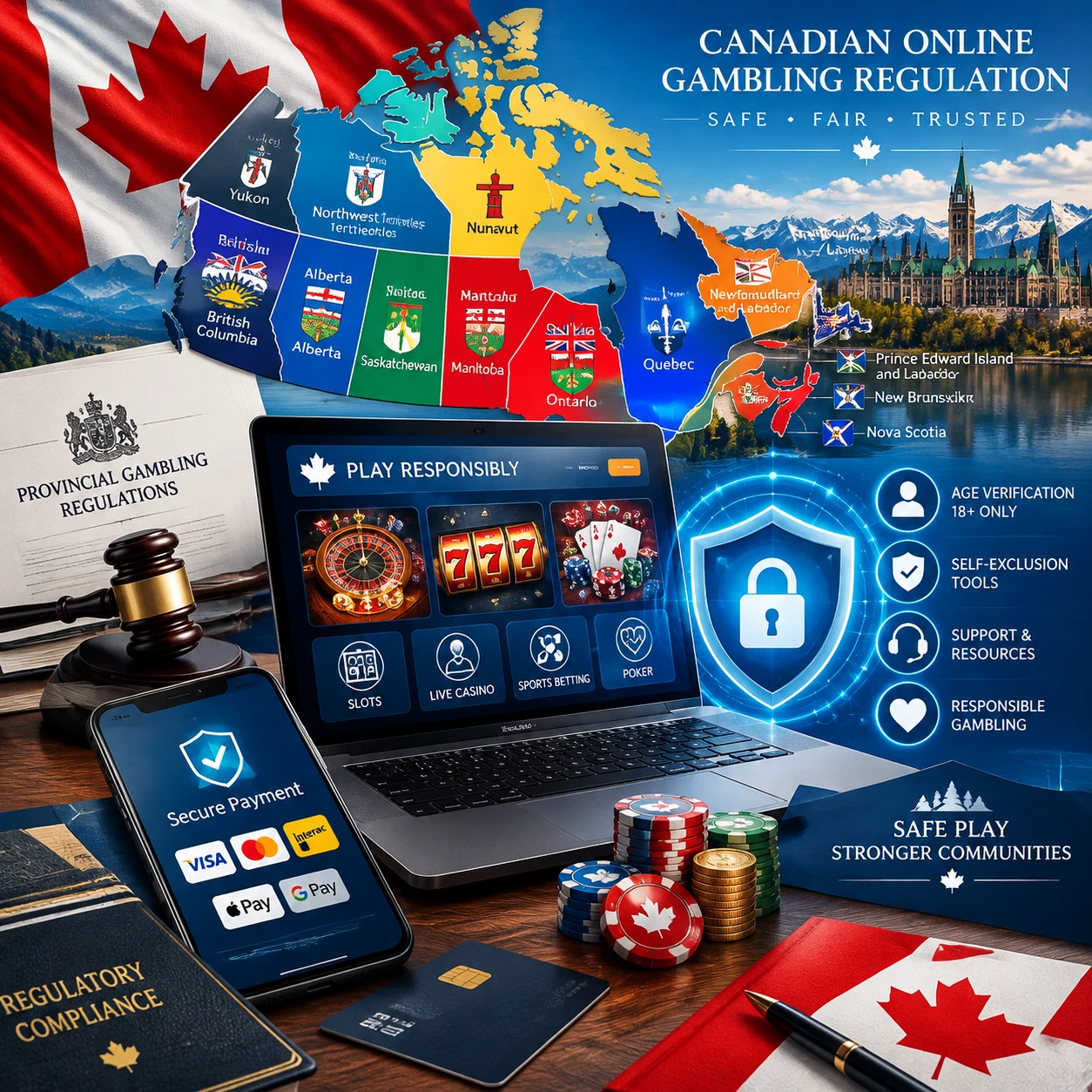
Here's something that trips up a lot of players: Canada doesn't have one national licensing body for online gambling. Not even close. Federal criminal law sets the outer boundaries, sure, but provinces and territories actually decide how gambling gets offered and policed on the ground. That patchwork setup means the rules shift depending on where you live — and in 2026, it's raised a fresh question I keep running into: how do you weigh a crypto casino against a provincially regulated site when the two don't play by the same rulebook?
I want to walk through who actually regulates online gambling here, what licensing and player protections look like in real terms, and how I personally check a platform before I ever hit 'deposit.' Rules shift, though, so don't take my word as final — confirm current requirements with your provincial regulator before you commit any money.
Canada's online gambling market used to be a simple patchwork of provincial lottery sites. It's grown into something messier — a mix of government-run platforms, regulated private operators in some provinces, and offshore services that aren't licensed locally at all. That evolution hasn't given us one tidy rulebook. Instead, local frameworks decide which operators can serve residents and what protections those operators owe them.
Meanwhile, crypto casinos have gotten louder. They'll advertise instant transactions or crypto-only bonuses, and that's fine — but speed and flashy perks don't mean a site is licensed in Canada. I've learned to separate marketing noise from legal status pretty quickly now. It's a habit worth building.
The federal Criminal Code lays down the general legal framework for gambling in Canada. But the actual authority to run and manage gambling — including through government agencies and provincially authorized operators — sits with provinces and territories. So the practical rules end up varying by location, and sometimes quite a bit.
Take Ontario. The Alcohol and Gaming Commission of Ontario (AGCO) regulates the market and registers eligible operators, while iGaming Ontario (iGO) runs the commercial side through agreements with those operators. Quebec does it differently: Loto-Québec operates the province's official online gambling platform directly. British Columbia leans on PlayNow, operated by BCLC. None of these setups are interchangeable — a licence in one province doesn't carry over everywhere else in the country. I'll say that twice because it trips people up constantly.
Ontario opened its regulated private-operator online gaming market back in 2022, and the model still gets referenced a lot. AGCO registers operators and suppliers, iGO manages the commercial arrangements for eligible private sites, and registered operators have to meet standards on integrity, player protection, and responsible gambling.
People talk about Ontario's approach as a benchmark because it lets multiple private brands operate under provincial oversight — that's genuinely unusual for Canada. Other provinces might study it, borrow pieces of it, whatever. But each one still makes its own call. Don't assume a national licensing system exists in 2026 just because Ontario's model gets so much attention.
Some Canadians can reach gambling sites licensed somewhere else entirely. An overseas licence, though, isn't the same thing as provincial authorization — not even close. What legal footing you have, and what recourse exists if something goes wrong, depends on the province, the operator, and the specific situation. Players often find it harder to resolve complaints, get funds back, or access local protections when the site has no relevant provincial authorization at all.
So here's my rule: don't trust a casino's claim that it 'accepts Canadians.' Check the regulator's official operator register instead, and look at the rules that actually apply where you live.
Requirements shift across jurisdictions, but regulated operators are generally expected to prove their games are fair, their systems are secure, and player safeguards actually exist — not just on paper. That usually means independent testing or certification of games, controls against fraud and collusion, privacy and cybersecurity measures, and clear procedures for handling complaints and withdrawals.
Operators also carry anti-money laundering (AML) obligations and identity-check requirements, which can include monitoring transactions and reporting anything suspicious under applicable law. Crypto payments don't erase these obligations — I want to be blunt about that. Depending on the payment route and the entities involved, digital-asset businesses might face separate registration and compliance requirements on top of everything else.
For background on payment and digital-asset compliance discussions, I'd point readers toward the bitcoin casino canada resource. Treat it as a starting point for your own research, though, not proof that any particular casino is licensed or endorsed by a regulator. Always verify licensing directly with the relevant provincial authority — always.
Player safeguards depend heavily on jurisdiction and platform — there's no single standard everyone follows. Regulated sites may need to verify a customer's age and identity, offer ways to set limits or pause play, and display information about gambling risks and support services. Provincial regulators can investigate compliance and apply measures under their authority, which might include conditions, penalties, or suspension of an operator's registration.
If a dispute comes up, keep records. Deposits, withdrawals, every communication — all of it. Start with the operator's complaint process, then check the regulator's official guidance on escalation. And here's the uncomfortable part: a player's options get noticeably more limited when the site isn't authorized in their province.
Before I play anywhere, I check whether a site makes its safeguards easy to find — not buried three menus deep. Common tools include:
These tools only matter if they're clear, accessible, and not easy to dodge. If gambling is causing stress or financial harm, use a pause or exclusion feature and reach out to a local support service. No shame in that — it's what the tools are there for.
Crypto casinos appeal to some players for obvious reasons — deposits and withdrawals can be fast, fees sometimes differ from conventional payment methods, and wallets don't always display a person's name publicly. But pseudonymous isn't the same as anonymous. Platforms can still require identity checks, and blockchain transactions can often be traced anyway.
Regulators run into real practical headaches when digital assets cross borders or pass through several services at once. Still, using Bitcoin doesn't exempt an operator from gambling, consumer-protection, or financial-compliance rules. The question that actually matters stays the same: is the platform authorized to offer gambling to residents in your jurisdiction? Everything else is noise.
The upside is real — convenient transfers, access to crypto-specific payment options. But the risks deserve just as much attention, maybe more. Digital-asset prices can swing sharply between deposit and withdrawal. Transactions are often hard or impossible to reverse. Complaint procedures can be murky at an unregulated site. And bonus terms? They can hide wagering or withdrawal conditions that are easy to miss if you're skimming.
Before sending any funds, check the exchange rate being used, network fees, withdrawal rules, identity requirements, and the operator's local licensing status. Never assume a crypto payment method hands you the same protections you'd get from a regulated payment provider — because it doesn't, not automatically.
I run a handful of checks before I even consider an online gambling site — dollars, Bitcoin, whatever digital asset it accepts, doesn't matter:
A polished website, cryptocurrency support, or an overseas licence — none of that, alone, is evidence of Canadian provincial authorization. I've seen plenty of good-looking sites that fail on this exact point.
In 2026, Canada's system is still shaped by provincial and territorial choices rather than one universal online-gambling licence. There's ongoing talk of shared standards, clearer crypto-specific guidance, stronger coordination between provinces — but players should learn to tell the difference between proposals floating around and rules that are actually in force right now.
Blockchain records can make certain transactions publicly verifiable, which sounds reassuring. But transparency at the payment level doesn't guarantee fair games, responsible conduct, or regulatory approval — those are separate questions entirely. For Canadian players, the most reliable approach stays simple: check local licensing, understand the protections actually available to you, and treat crypto convenience as a payment feature, not a substitute for compliance.